
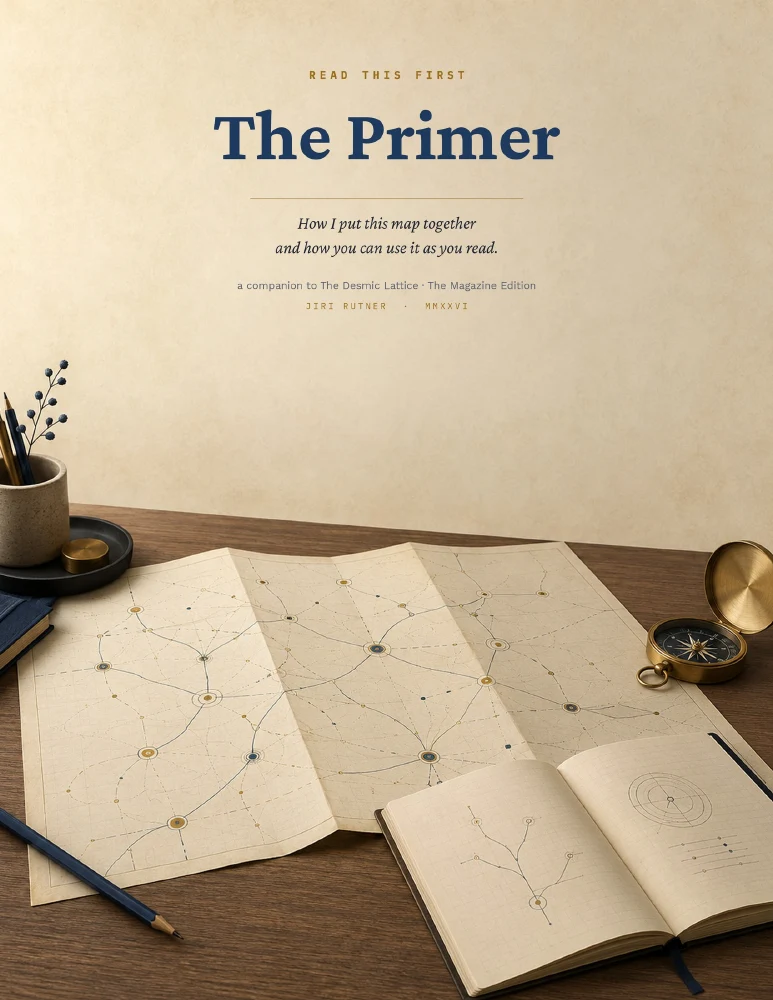
 01
The Primer
15 pages · PDF · Free
The Primer introduces the central questions and terms of the Lattice. It is a short, free starting point for anyone willing to look closely at experience.
Read for freeExploring the structure of consciousness
I suggest starting with The Primer: ten minutes on how the map was made. From there, read the Magazine Edition, then the Professional Reference when you want the full argument. All three are free. Go to the Magazine Edition→
“Consciousness does not emerge from matter.— From The Desmic Lattice
Matter emerges within consciousness.”
You can read the publications in order or begin with the one that suits the time you have. All are free. The accompanying Plate Collection is available separately as clean artwork or annotated images.
01
15 pages · PDF · Free
The Primer introduces the central questions and terms of the Lattice. It is a short, free starting point for anyone willing to look closely at experience.
Read for free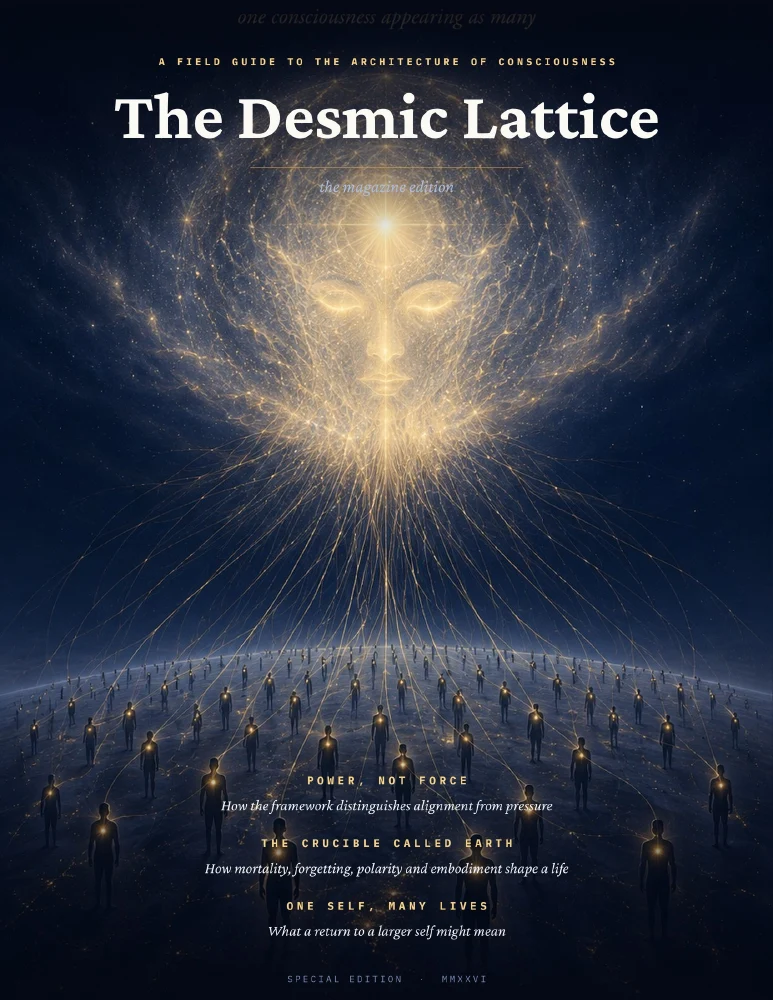 02
16 pages · PDF · Free
The Magazine Edition presents the central argument in a shorter, visually spacious form, designed to be read in a single sitting.
Read for free 03
80 pages · PDF · Free
The complete work has two parts. The first develops the model in full. The second considers 31 theories and related questions across seven families, from the Hard Problem to panpsychism, explaining where each fits and where either it or the Lattice goes beyond the evidence.
Read for free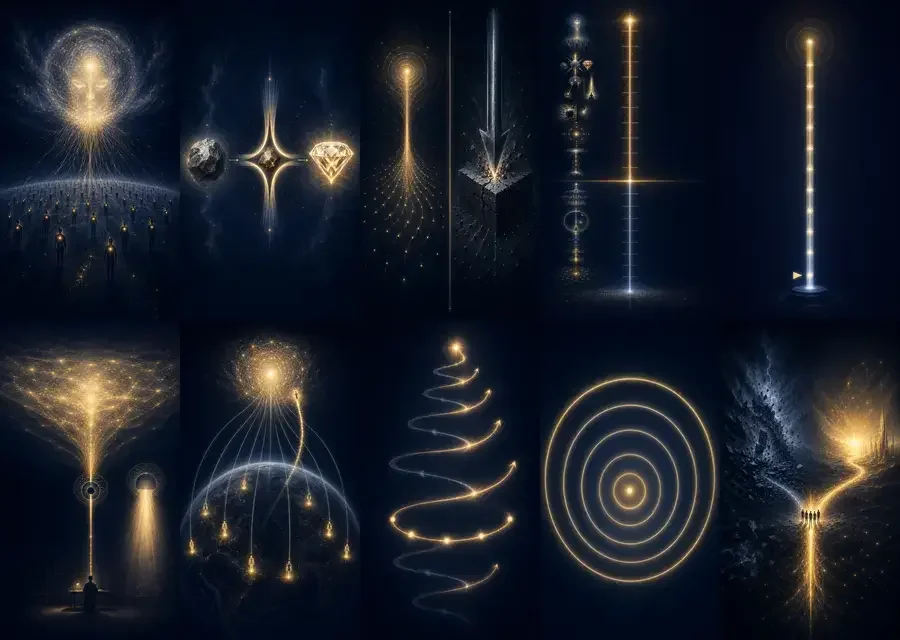 04
10 plates · Two ZIPs · Free
The complete art collection, in two versions: clean full-resolution PNGs or annotated JPGs with captions. Both download directly, with no email or account.
View free downloadsThe Primer and the Magazine Edition download directly. The Professional Reference asks only for an email to issue a private link, with no account; emails about future projects are a separate, optional opt-in. The illustrated plates are a separate free art collection, ready to download clean or annotated.
Open the libraryFree · No account · No payment
Thirty major ideas about consciousness are considered alongside one another, with attention to where each fits and where that fit reaches its limits.

The first part develops the Lattice step by step, explaining the structure of consciousness, defining terms as they appear, and following the full argument through to its conclusions.
The second half considers 31 theories and related questions across seven families, from the Hard Problem to panpsychism to the physics of emergent space. For each, it explains the relationship to the Lattice and where either account goes beyond the evidence.
You are a small, temporarily forgetful piece of one enormous consciousness, living inside an intense school, bound to the whole by relationship rather than by force, in order to grow.
The Desmic Lattice, in Plain Language
My writing brings together phenomenology, cognitive science and contemplative practice. The Desmic Lattice grew out of years of asking what awareness is, where it comes from, and why conventional accounts keep falling short in explaining it.
I want to be precise without making the explanation academic or losing its depth. The question for me is whether a map matches direct experience, rather than simply repeating an inherited theory.
The Lattice is my attempt to develop that map.
I also use this multidisciplinary approach in GovActivate, my consulting practice for local government and complex public work, where I develop frameworks, translate between perspectives and look for useful signals within complex institutions.
The Desmic Lattice is a conceptual framework I developed to explore how consciousness is structured. It considers how awareness is organized, what its basic features are, and how experience relates to the world without reducing one to the other. It draws on phenomenology, cognitive science and direct observation.
Start with The Primer for an introduction to the questions and terms. The Magazine Edition then presents the central argument in one sitting, and the Professional Reference Edition develops it in full, with its supporting structure. All three are free in the library, alongside a separate collection of the art plates.
No. I have written it for people willing to look carefully at a question, whether or not they have studied these subjects. Technical terms are introduced gradually and explained when they appear.
Each edition is a free, high-resolution PDF in the library. The Primer and the Magazine Edition download directly. The Professional Reference asks for an email address to issue a private, time-limited link on the page; it is not verified. You may separately opt in to emails about future similar projects. That choice is never required for a download. See privacy. The ten art plates are a separate free download, clean or annotated, with no email at all: see the plates.
Yes. Every edition is free to read. No payment is required. Only the Professional Reference PDF asks for an email address.
Yes. I am continuing to develop the Lattice. Revisions go into the free library, so the text you download is the current version. New standalone publications are also in development.
The Primer is free and fifteen pages long.
It gives you enough context to decide whether to read further.
Free · No account · All three publications in the library · The plates

