Nodes
Points of concentrationPoints where awareness or agency concentrates. A node only makes sense in relationship to the lattice around it. A person, a team, a decision, an institution, all are nodes.
The Desmic Lattice: a framework of consciousness for understanding how systems cohere, fracture, and become whole
The Desmic Lattice is a framework for understanding systems, how they cohere, fracture, reorganize, and become whole again. It began as a study of consciousness, built by mapping where seventeen independent thinkers agree without conferring, but the pattern applies anywhere relationships carry load: organizations, governments, families, a single hard decision. It asks for no belief, only whether the lens makes your own situation clearer.
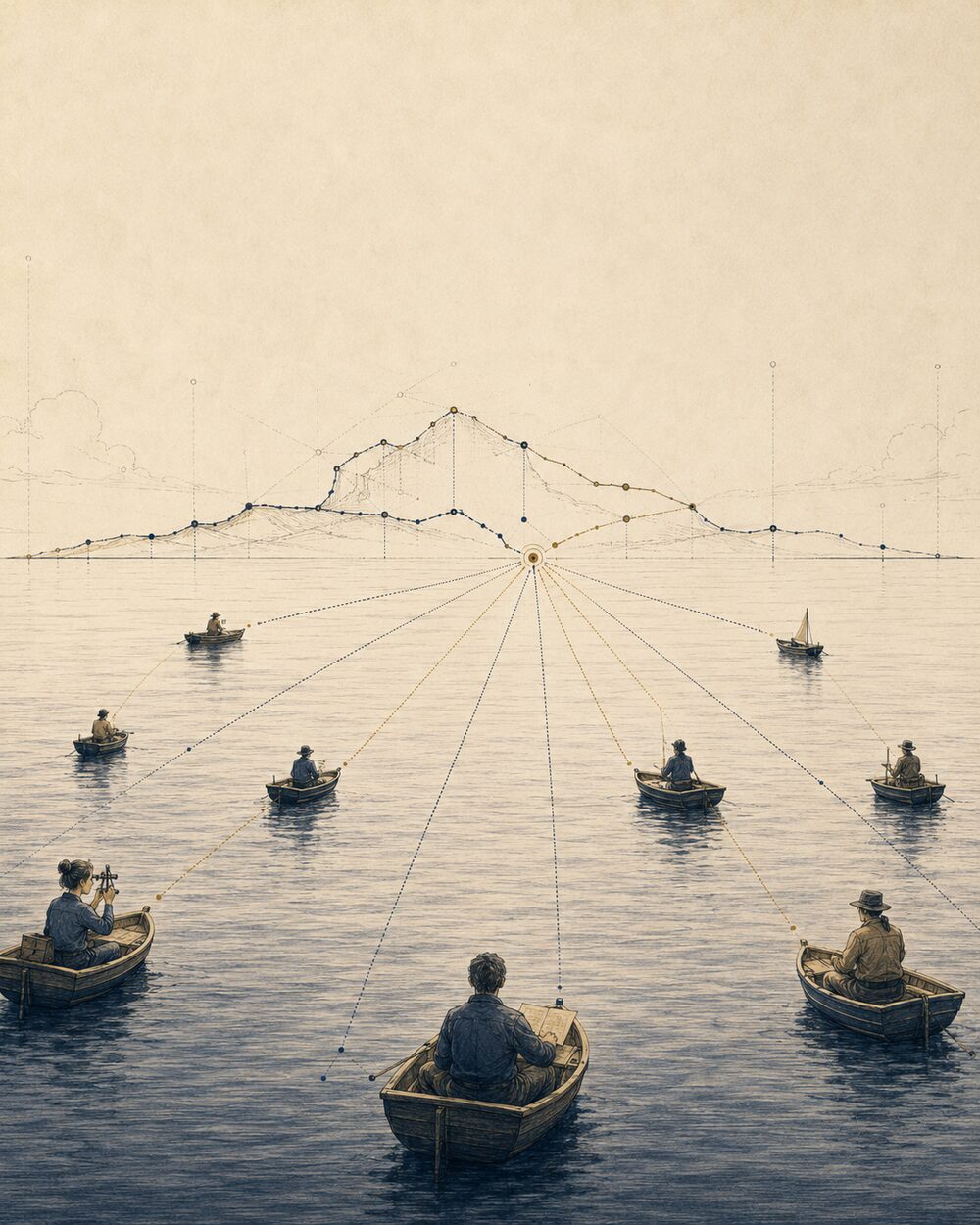
The name comes from the Greek desmos, meaning a bond, so the Desmic Lattice means the web held together by binding tensions. Two central claims anchor it.

It is a map, not a doctrine. It is not proven and says so plainly. Hold it lightly.
These are not jargon to memorize. They are orientations, a way of paying a different kind of attention to whatever system you are currently inside.
Points where awareness or agency concentrates. A node only makes sense in relationship to the lattice around it. A person, a team, a decision, an institution, all are nodes.
The relationships between nodes, where the real work of a system happens. Most org charts show nodes. The pain lives in the threads the chart does not draw.
The pull a thread carries. Tension is information. A thread under no tension is a thread carrying nothing. The question is whether the structure is built to hold it.
Alignment without force. Different from control, and the only version that survives the controller leaving the room. Coherence is when a system holds because the pieces actually fit.
Not always failure. Sometimes the signal the structure was no longer true, that the threads had been carrying a load they were not built for. Collapse clears what renewal needs.
What becomes possible when pieces reorganize around what is load-bearing. Renewal begins when the outer frame is seen clearly, not when the pressure is removed.
Gather the views you resist and use the disagreements as boundary markers until the whole problem's shape appears. The outer frame is built from what you have been excluding.
Force pushes and burns fuel. Power pulls by being worth aligning with. Most of what looks like causation in complex systems is alignment, not push.
A person trying to make a difficult decision. A team trying to resolve a conflict without losing what it built. A company trying to act without abandoning its center. A public agency trying to serve people inside real constraints. The Desmic Lattice names the structure underneath those moments: what is seen, what is assumed, what is avoided, what is connected, and what becomes possible when the pattern is finally visible.

The Desmic Lattice is the underlying pattern language. GovActivate is one applied expression of it, focused on public institutions and communities making decisions under real constraints: how decisions move, where structures fragment, and how civic teams can act with more clarity.
When a system strains, read it before pushing or fleeing. The work is not to impose meaning but to see the structure clearly enough to act with integrity.